
E-commerce SEO vs Regular SEO: Key Differences Explained
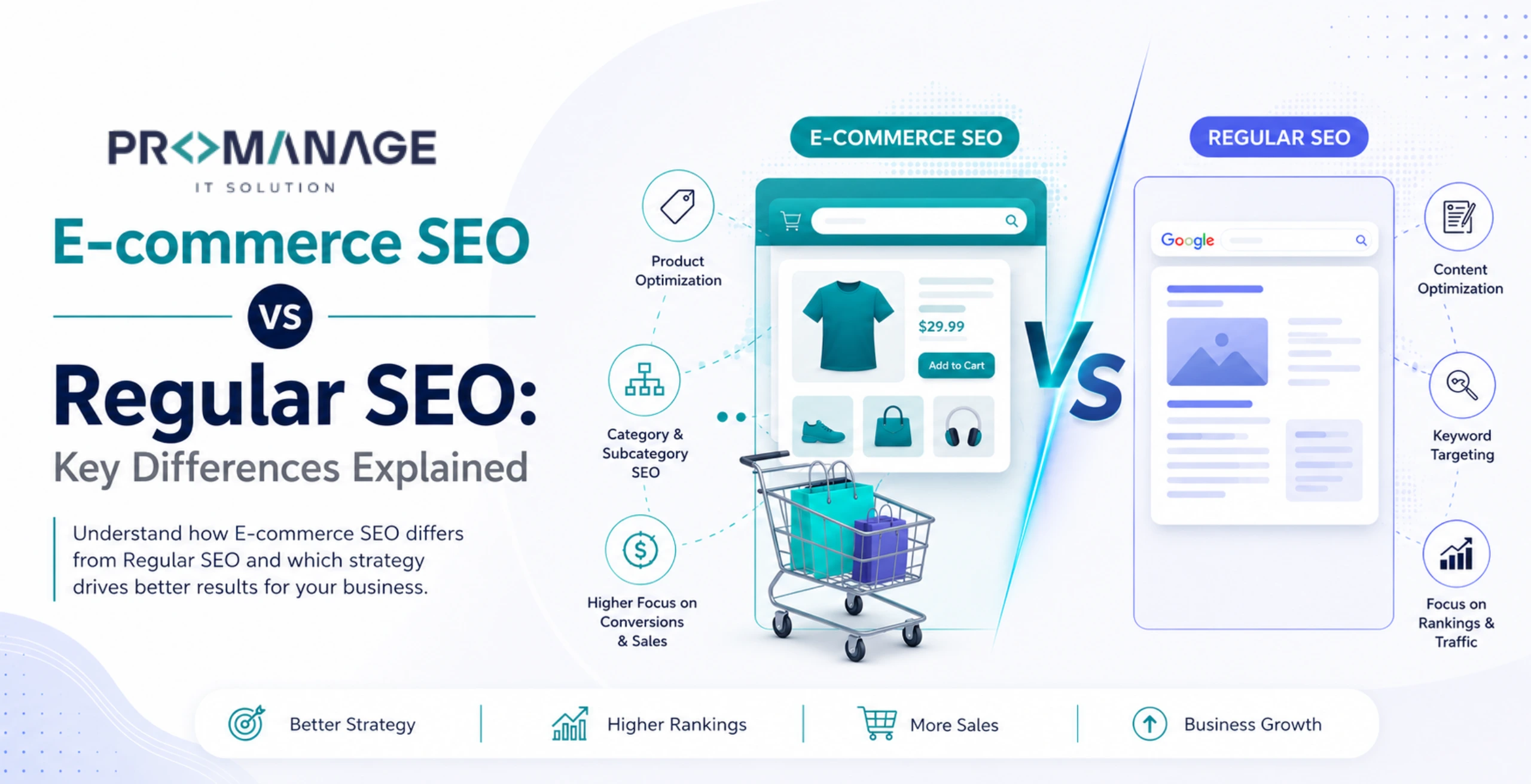
If you have been reading general SEO advice and trying to apply it to your online store, you have likely noticed something: most of it does not quite fit. That is because E-commerce SEO is genuinely different from standard website SEO in strategy, execution, technical requirements, and priorities. This guide explains every key difference — and what it means for how you should approach optimizing your store.
What Is Regular (Standard) SEO?
Standard SEO refers to optimizing websites that are primarily informational, service-based, or business-focused — law firms, agencies, SaaS companies, blogs, portfolios, local businesses. The goal is typically to drive awareness, generate leads, or earn direct contact enquiries. The purchase or conversion happens offline or through a contact form, not on the website itself.
Standard SEO focuses heavily on content marketing, backlink building, and local signals. A typical standard SEO site might have 20–100 pages total. Keyword targeting is relatively straightforward: each page targets a small cluster of related terms.
What Is E-commerce SEO?
E-commerce SEO is the optimization of online stores — Shopify, WooCommerce, Magento, BigCommerce, custom-built stores — to drive organic traffic that converts directly into purchases. Every page must be optimized not just to attract visitors, but to drive them through a purchase funnel entirely on the website.
An e-commerce site can have anywhere from 100 to 100,000+ pages: product pages, category pages, filter pages, brand pages, collection pages, and blog content. This scale creates both enormous opportunity and unique technical complexity.
| Scale Difference: A standard service website might have 30 pages to optimize. An e-commerce store selling 500 products in 20 categories can have 5,000+ indexable URLs. This scale fundamentally changes how SEO must be approached and managed. |
Key Differences: Side-by-Side Comparison
| Standard SEO | E-commerce SEO |
| 20–200 pages typical | 100–100,000+ pages typical |
| Conversion: leads / enquiries | Conversion: Direct online purchase |
| Primary focus: Blog + service pages | Primary focus: Product + category pages |
| Keyword intent: Informational / local | Keyword intent: Transactional / commercial |
| Duplicate content: Rare issue | Duplicate content: Major ongoing problem |
| Crawl budget: Rarely a problem | Crawl budget: Requires active management |
| Schema: LocalBusiness / FAQ | Schema: Product / Review / Offer |
| Purchase: Offline or contact form | Purchase: Entirely on-site |
| Link building: Brand authority | Link building: Product + category authority |
| Content: Guides, blogs, landing pages | Content: Product descriptions, buying guides |
Difference 1: The Keyword Strategy Is Completely Different
In standard SEO, you mostly target informational and navigational keywords: ‘how to choose an accountant,’ ‘best digital marketing agency in Delhi,’ ‘what is cloud telephony.’
In e-commerce SEO, the most valuable keywords are transactional and commercial: ‘buy running shoes online,’ ‘iPhone 16 Pro case with MagSafe,’ ‘organic protein powder 1kg price.’ These keywords signal purchase intent — the user is ready to buy, not just research. They drive revenue directly, not just traffic.
- Category Page Keywords: Broad, high-volume product category terms: ‘men’s running shoes,’ ‘organic skincare products’
- Product Page Keywords: Specific, long-tail purchase-intent terms: ‘Nike Air Zoom Pegasus 41 size 10 grey’
- Blog Keywords: Research-phase terms that capture buyers early: ‘best running shoes for flat feet 2026’
Difference 2: Technical SEO Is Far More Complex
Standard SEO technical issues are usually straightforward: fix crawl errors, improve page speed, add schema, sort out redirects. E-commerce technical SEO is a completely different challenge in scope and complexity:
- Faceted navigation / filter pages create thousands of duplicate or near-duplicate URLs (the #1 e-commerce SEO problem)
- Pagination management: /page/1/, /page/2/ — must be handled without diluting link equity
- Out-of-stock product pages — should they be kept, redirected, or noindexed?
- Product variant URLs — when every size and color has its own URL, duplicate content explodes
- Crawl budget management — Google has limited crawl capacity; wasting it on filter pages means important product pages get crawled less frequently
- Canonical tags must be implemented precisely across thousands of pages
- Site speed at scale — product images across thousands of pages require aggressive optimization
Difference 3: Content Strategy Is Inverted
In standard SEO, content strategy is primarily about publishing blog articles that drive awareness and build authority. Blog content is often the primary traffic driver.
In e-commerce SEO, product and category pages are the primary revenue drivers — blog content plays a supporting role in capturing top-of-funnel, research-phase traffic. This means:
- Product Descriptions: Must be unique, benefit-focused, keyword-optimized, and conversion-oriented — not copied from manufacturer spec sheets (a massive duplicate content risk)
- Category Page Content: The text block at the top or bottom of category pages is an underused SEO goldmine — 200–400 words of keyword-rich, helpful content here significantly boosts category page rankings
- Buying Guides: Bridge the gap between research and purchase: ‘How to Choose the Right Protein Powder for Your Goals’ links naturally to relevant product category pages
Difference 4: Link Building Targets Are Different
Standard SEO link building focuses on building brand authority: getting mentioned in industry publications, guest posting on relevant blogs, earning citations in local directories.
E-commerce link building must drive authority to category and product pages directly — not just the homepage. This requires:
- Product PR: Getting products reviewed by bloggers, YouTube creators, and influencers who link back to specific product pages
- Category Page Links: Earning links to ‘men’s running shoes’ category pages from running websites and fitness publications
- Resource Page Links: Getting listed in gift guides, best-of roundups, and buying guides that link to specific products
Difference 5: Measuring Success Is Different
Standard SEO measures: organic traffic, keyword rankings, leads generated, and cost per lead. E-commerce SEO measures all of that plus:
- Organic revenue — direct sales attributed to organic search sessions
- Organic conversion rate — what percentage of organic visitors make a purchase
- Revenue per organic session — how efficiently organic traffic is monetizing
- Product page visibility in Google Shopping — schema-enabled rich results
- Category page rankings for high-volume transactional terms

Related Posts





SEO Team Lead
Preeti is a skilled SEO Team Lead passionate about boosting organic traffic and improving search rankings. She leads with data-driven strategies to help businesses grow online effectively.