
Local SEO vs National SEO: Which One Does Your Business Actually Need?
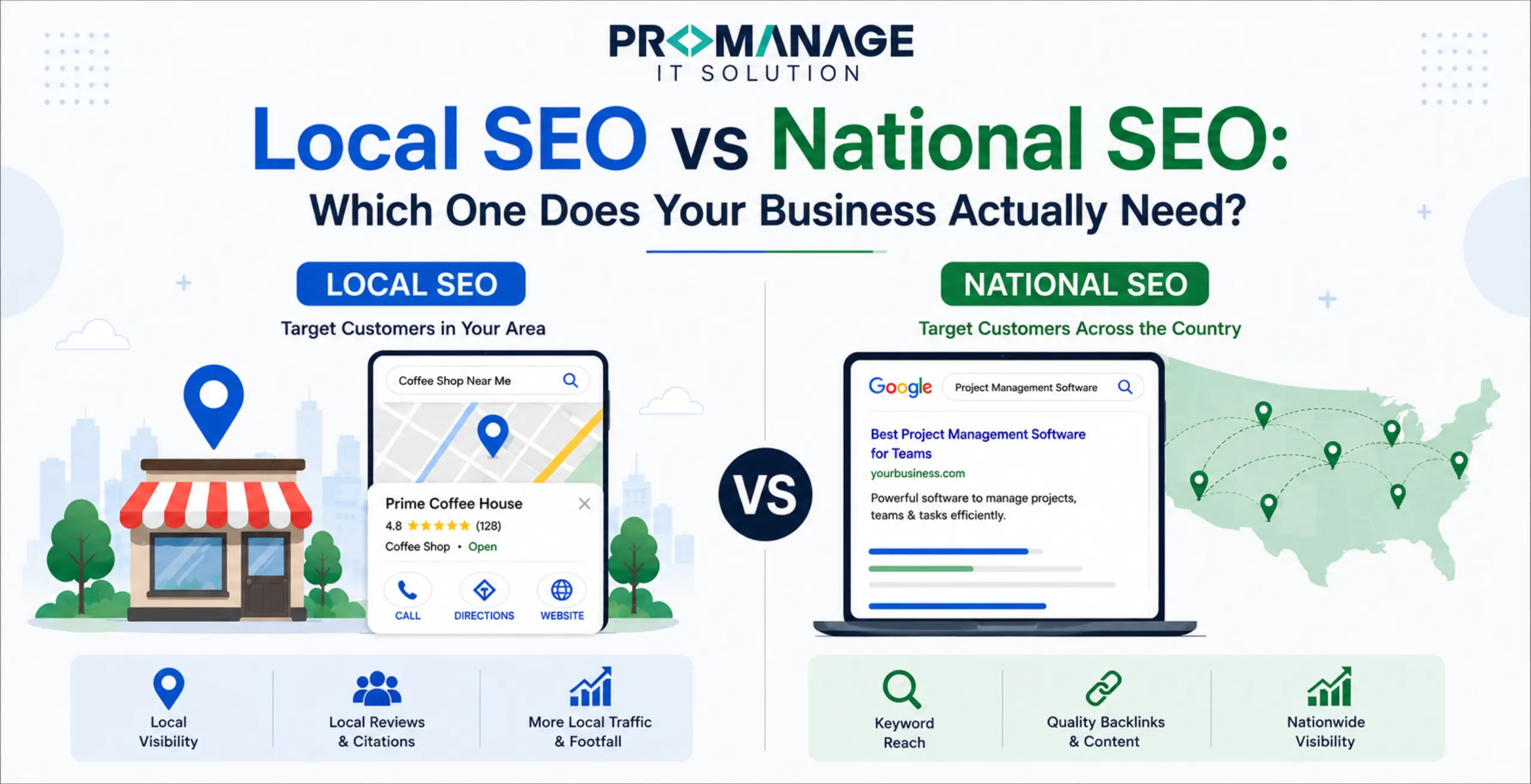
Choosing between Local SEO and National SEO is one of the most critical strategic decisions a business makes, and most get it wrong. Either they invest in broad national SEO when they only serve two cities, or they ignore local signals when they could dominate their region quickly and cheaply. This guide settles the question definitively.
What Is Local SEO and Who Is It Really For?
Local SEO is the practice of optimizing your online presence to appear in searches with geographic intent: ‘dentist near me,’ ‘SEO agency in Noida,’ ‘best restaurant in Connaught Place.’ It focuses on dominating a specific geographic area rather than an entire country or global market.
Local SEO primarily involves: Google Business Profile optimization, local citations (NAP consistency, Name, Address, Phone), location-specific landing pages, local backlinks, and earning verified reviews. The primary goal is to appear in the Map Pack, the 3 businesses shown in a map snippet at the top of Google results, as well as in local organic listings beneath it.
| Who Needs Local SEO: Restaurants, clinics, law firms, real estate agents, plumbers, electricians, home service businesses, retail shops, fitness studios, schools, and any business where the customer must physically visit or is located in a specific city or region. |
What Is National SEO and Who Is It For?
National SEO targets broad, non-geographic keywords to attract audiences across an entire country, or even globally. The goal is to rank for high-volume, competitive terms regardless of where the searcher is located: ‘best project management software,’ ‘how to file income tax return,’ ‘cloud accounting tools for freelancers.’
National SEO requires significantly more resources: higher domain authority, a stronger backlink profile, more comprehensive content, longer timelines, and bigger budgets. The rewards, however, are proportionally larger, a #1 ranking for a national keyword can drive tens of thousands of visitors per month.
| Who Needs National SEO: SaaS companies, e-commerce brands selling nationwide, online education platforms, media and publishing websites, affiliate sites, and any business where geography does not restrict the customer. |
Local SEO vs National SEO: Side-by-Side Comparison
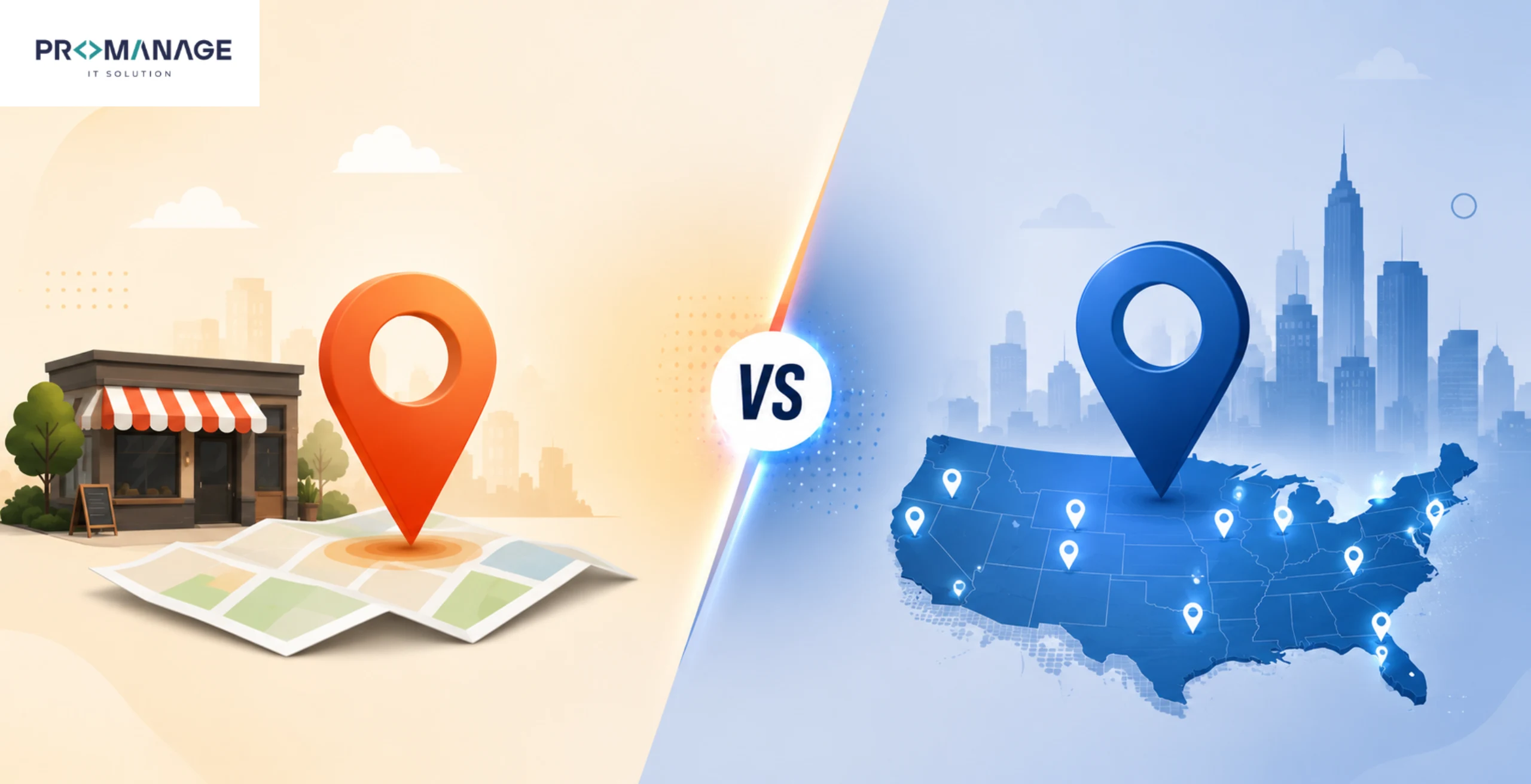
| Local SEO | National SEO |
| Geographic target: city / region | Geographic target: entire country or global |
| Keywords: ‘service + location’ | Keywords: broad, high-volume terms |
| Results timeline: 2–4 months | Results timeline: 6–18 months |
| Cost: Lower (less competition) | Cost: Higher (more competition) |
| Primary tool: Google Business Profile | Primary tool: Domain authority & content |
| Metric: Map Pack rankings & calls | Metric: Organic traffic & conversions |
| Backlinks: Local directories, citations | Backlinks: High-authority national sites |
| Content: Location pages, local guides | Content: Pillar pages, deep guides |
| Competition: Local businesses only | Competition: National & global brands |
| ROI speed: Fast | ROI speed: Slow but high volume |
The Decision Framework: Which One Do You Actually Need?
Answer these three questions honestly:
Question 1: Do your customers need to be near you?
If your service requires the customer to be physically present, either visiting your location or you visiting theirs, you need Local SEO. A plumber in Delhi cannot help someone in Chennai. A restaurant in Bandra cannot serve someone in Pune. Geographic relevance is everything.
Question 2: Do you serve multiple cities or have multiple locations?
If you operate in 3+ cities or have branches across regions, you need a hybrid approach: individual location-specific pages optimized for local SEO combined with a national domain authority strategy. This is the model ProManage uses for multi-city service clients.
Question 3: Is your business or product fully online?
If customers can purchase, subscribe, or engage with you from anywhere without geography being a barrier, e-commerce, SaaS, digital services, National SEO is your primary strategy. Local SEO still applies for brand office city presence, but it is not your revenue driver.
The Hybrid Approach: When You Need Both
Many businesses require a blend. A law firm with offices in Mumbai, Delhi, and Bangalore needs both. An SEO agency targeting Indian SMBs and international clients needs both. Here is how to structure the hybrid:
- Main Homepage: Target national or industry keywords, broad, high-intent
- Location Pages: One dedicated page per city with unique content, local schema, and localized testimonials
- Google Business Profiles: One verified GBP listing per physical location
- Content Strategy: National blog content builds domain authority; local content drives map rankings
- Link Building: Mix of high-authority national links and local citation directories
Common Mistakes to Avoid
- Targeting national keywords with a local budget, you will never rank
- Ignoring Google Business Profile for a location-based business, this is your biggest local asset
- Using the same content on all location pages, Google will identify and penalize thin duplicate content
- Skipping local schema markup, this signals to Google exactly where you operate
- Not getting local reviews, reviews are a top-3 ranking factor for the Map Pack
Frequently Asked Questions
Q: Can a small local business compete with national brands in Google?
Yes, but only in local search. A local bakery cannot outrank Britannia for ‘biscuits,’ but it absolutely can rank #1 in Google Maps for ‘bakery near me in Lajpat Nagar.’ This is why Local SEO exists, it levels the playing field geographically.
Q: What if I start local and want to go national later?
This is the ideal growth path. Build local authority first, generate revenue, then scale nationally using the domain authority you have earned. Starting national immediately is expensive and slow for most small businesses.
Q: Is Google Business Profile optimization actually important?
It is arguably the single most important local SEO asset. An optimized, regularly updated GBP with verified reviews can put you in the Map Pack, which gets more clicks than organic results for local searches. Never neglect it.
Q: How many location pages do I need?
One dedicated, unique page per city or area you serve. Each page must have original content specific to that location, not just swapped city names. Google penalizes templated location page spam.

Related Posts








SEO Team Lead
Preeti is a skilled SEO Team Lead passionate about boosting organic traffic and improving search rankings. She leads with data-driven strategies to help businesses grow online effectively.