
BRICS 2026: Resilience, Innovation, Cooperation and Sustainability
What India’s Presidency Means for the World Economy!!
BRICS is back in the news, and guess what…!!
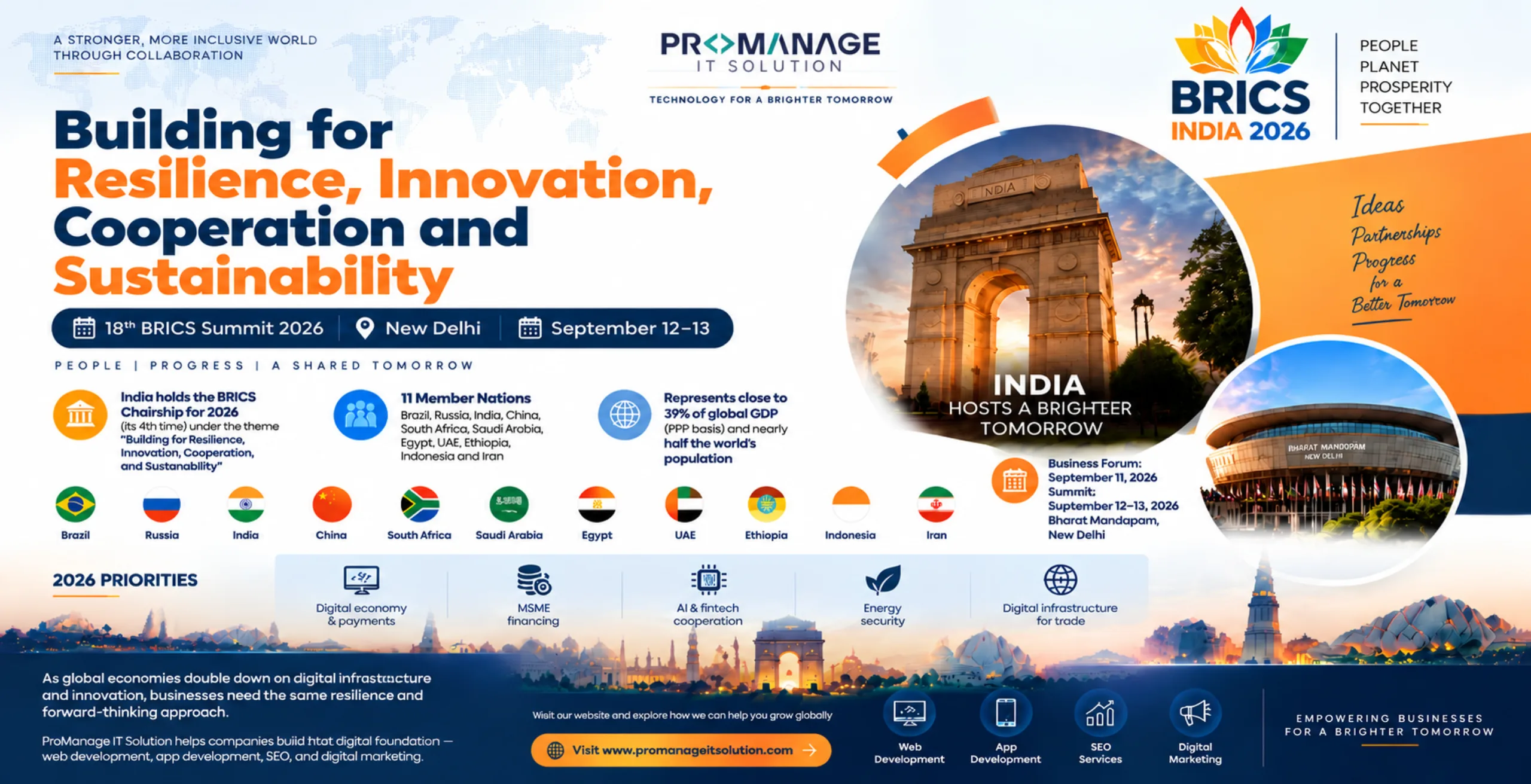
India is running the show this year. As the current chair, India is hosting the 18th BRICS Summit in New Delhi on September 12–13, 2026. That makes this a good moment to look at what BRICS actually is, what India wants from its presidency, and how much economic weight this group really carries.
What Is BRICS?
BRICS started as an idea before it became a group. The term “BRIC” described four fast-growing economies: Brazil, Russia, India and China. Their foreign ministers first met in New York in September 2006, and the first leaders’ summit followed in Yekaterinburg, Russia, in June 2009. (brics2026.gov.in)
South Africa joined soon after, turning BRIC into BRICS. The group stayed at five members for over a decade, then expanded sharply: Egypt, Ethiopia, Iran, Saudi Arabia and the United Arab Emirates became full members from January 2024, and Indonesia joined in January 2025. (brics2026.gov.in)
At its core, BRICS is an informal forum, not a treaty organization, with no permanent secretariat, no binding charter. Member countries take turns holding the yearly chairship and use summits and working groups to coordinate on trade, finance, technology, and development. It has become a key platform for large Global South economies to push for changes at the UN, IMF, World Bank, and WTO. (brics.br)
The official BRICS website confirms all 11 countries
As of September 2026, BRICS has 11 full members: Brazil, Russia, India, China, South Africa, Saudi Arabia, Egypt, the United Arab Emirates, Ethiopia, Indonesia and Iran. This list is confirmed on both the official BRICS Brazil site and India’s (brics2026.gov.in) presidency website. (brics2026.gov.in) Older lists showing only five or six countries are outdated and no longer reflect the group’s current membership.
India’s BRICS Presidency 2026
India took over the BRICS chairship on January 1, 2026, its fourth time holding the role, after 2012, 2016, and 2021. External Affairs Minister S. Jaishankar formally launched the presidency, along with its logo and website, on January 13, 2026.
The official theme is “Building for Resilience, Innovation, Cooperation, and Sustainability.” India frames this around a “Humanity First,” people-centric approach, meaning the agenda leans toward practical outcomes, farmer support, small-business financing, and digital health tools, rather than only diplomatic statements. (brics2026.gov.in)
Throughout the year, India has hosted ministerial and working-group meetings on agriculture, health, energy, trade, customs, cybersecurity, and counter-terrorism, building toward the September summit.
When and Where Is the BRICS Summit 2026?
The 18th BRICS Summit will be held on September 12–13, 2026, at Bharat Mandapam in New Delhi, with the BRICS Business Forum taking place a day earlier, on September 11. As of September 9, 2026, the summit has not yet taken place; leaders are still expected to arrive, and no summit declaration has been issued. Any outcomes discussed in this article are expectations based on India’s announced priorities, not confirmed decisions.
What Are the Main Priorities of BRICS 2026?
India’s chairship has organized its agenda around a wide set of practical themes:
- Trade and supply chains: Deeper trade ties and reducing the risk of disruptions in food, energy, and manufacturing inputs.
- Digital economy and payments: Shared digital public infrastructure and local-currency payment options.
- Technology and MSMEs: Cooperation on AI and fintech, plus financing access for small and medium businesses.
- Energy security: Coordinating among countries that together produce a large share of the world’s oil, gas, and coal.
- Healthcare and agriculture: Shared digital health tools and farming technology.
- Infrastructure finance: Expanding the New Development Bank’s role in funding projects.
- Global South cooperation: Using BRICS to raise developing-country concerns at the UN, IMF, and World Bank.
These connect to specific working groups and proposals India has pushed during its chairship year, not just talking points.
BRICS 2026 and its Advantages in Different Domains
- Economy and trade: India has proposed a BRICS invoice discounting mechanism to help exporters access trade finance faster, along with a Global Value Chains Action Plan for 2026–2030. (Tribune India)
- Digital technology and payments: A digital public infrastructure repository has been proposed so member states can share systems similar to India’s own digital payment rails.
- Energy: With members ranking among the world’s top oil, gas and coal producers, energy security and smart-grid cooperation remain recurring agenda items.
- Healthcare and agriculture: Ministers have discussed universal health coverage and digital health tools, while India coordinates the BRICS Network on Digital Agriculture, which aims to bring AI and satellite data into farming across member countries. (ANI)
- MSMEs and infrastructure: A proposed BRICS MSME Cooperation Portal would connect small businesses with financing and technology centres, while the Shanghai-headquartered New Development Bank remains the group’s main infrastructure financing arm.
- Culture: India’s calendar has also included film and academic exchanges meant to build public familiarity with BRICS beyond government circles.
How Powerful Is BRICS Economically?
BRICS carries real economic weight, but the numbers need context. According to official BRICS data, the 11-member grouping accounted for about 39% of global GDP in 2023, measured on a purchasing power parity (PPP) basis. (brics.br)
Purchasing power parity is simply a way of comparing economies by what money can actually buy in each country, rather than converting everything into US dollars at market exchange rates. Because goods and services are cheaper in many BRICS countries, their PPP-based GDP share looks larger than their share measured in plain dollar terms, so it’s important to know which method is being used before comparing figures.
Beyond GDP, BRICS members also produce a striking share of global energy resources. Official BRICS figures put the group’s share of world oil production at around 43.6%, natural gas at about 36%, and coal at roughly 78.2%. (brics.br) With China and India both counted among the world’s most populous nations, the 11 members together also represent close to half of the global population.
Why Is BRICS 2026 Important for India?
Holding the chairship gives India a chance to shape the agenda rather than just respond to it. Potential benefits include:
- Wider trade access across a large, diverse group of economies;
- A model role for India’s digital payment systems;
- More export and partnership opportunities for Indian MSMEs;
- Continued energy security cooperation given India’s reliance on imported oil and gas; and
- A platform to push Global South and multilateral-reform priorities on the world stage.
None of this is automatic. BRICS is a forum for coordination, not a body that can force outcomes, so these benefits depend on follow-through after the summit, not just on the meetings themselves.
What Can We Expect From the BRICS Summit 2026?
Based on India’s officially announced priorities and credible reporting, leaders are expected to discuss trade cooperation, supply chain resilience, digital payments, MSME financing, energy security and reform of institutions like the UN Security Council. Reports suggest Chinese President Xi Jinping may attend, along with leaders from South Africa, Egypt, Indonesia, Iran and Ethiopia. (Brut India)
Since the summit has not yet happened as of September 9, 2026, none of this should be read as confirmed outcomes. The actual declarations, agreements, and joint statements will only be known once the leaders’ meeting concludes on September 13.


Aditi is an SEO content strategist and writer with experience delivering long-form blogs, website copy, and multilingual content for global clients. She excels at turning industry-specific subjects into clear, search-optimised content that drives business results.